
Last updated 13 October 2026
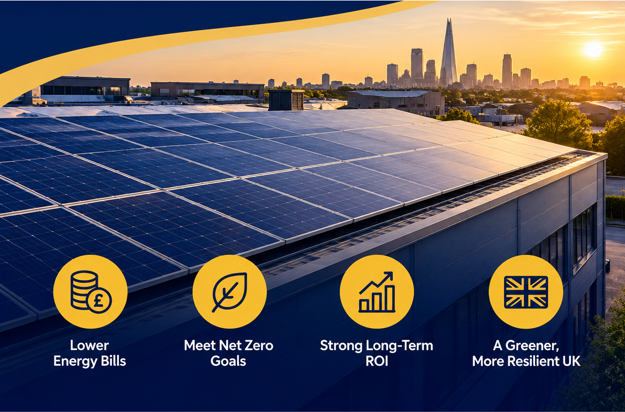
Energy bills have stopped being a background cost. For many UK businesses, they’re now one of the biggest overheads you can actually do something about, and the non-energy charges on your invoice keep creeping up. So one question comes up again and again: should we put solar on the roof?
The short answer is that for many businesses with daytime demand, yes. But it only pays off if you get a few basics right first. Here’s what we tell our clients.

Why solar is back on the table?
Three things have shifted in solar’s favour. First, generation costs. New onshore wind and solar now generate at roughly £40–£50 per MWh, well below gas-fired power at £85–£110. Second, payback. A rooftop system typically costs between £18,000 and £60,000 and pays back in around four to seven years. Third, network charges. A 64% rise in TNUoS charges was confirmed from April 2026, which makes every kilowatt hour you generate yourself more valuable than one bought from the grid.
Solar is also proving itself at scale. Solar output in Great Britain rose by nearly a third in 2025, helped by a record-sunny year and a big expansion in installed panels.
Is your business a good fit?
Solar works best when you use power while the sun is shining. Ask yourself:
Do we use most of our electricity between 8am and 6pm? Offices, warehouses, factories, schools, care homes and retail often suit.
Do we own the roof, or have a lease long enough to justify the investment? Landlord consent matters.
Is the roof in good condition, with decent space and little shade? A roof that needs replacing in five years is a problem.
Do we know our half-hourly usage? Without that data you’re guessing.
If you answered yes to most of these, it’s worth getting quotes. If your biggest loads run overnight, battery storage or a different approach may suit you better.
Three ways to pay for it
You don’t need £40,000 in the bank to go solar.
Buy outright. You keep every saving and any export income, and you get the fastest payback. The cost is cash up front and responsibility for maintenance.
Finance or lease. This spreads the cost so that, in the best cases, your savings cover the repayments from day one. Check the total cost over the full term, not just the monthly figure.
Power purchase agreement (PPA). A third party installs and owns the system on your roof, and you buy the power it generates at an agreed rate below grid price. There’s no capital outlay, but you give up some long-term upside, and terms can run for many years. Read them carefully.
Do the cheap wins first
Before you spend on generation, reduce what you need to generate. Small and medium-sized businesses account for just over half of business energy use, and nearly half of that could be cut through efficiency measures. eunomia
Start with the basics: LED lighting with sensors, better heating and cooling controls, fixing compressed air leaks, switching off equipment out of hours, and smart metering so you can see where energy goes. Many of these cost little and pay back within a year or two. They also mean you can install a smaller, cheaper solar system sized to your real demand.
Don’t forget your energy contract
This is the step most businesses miss. Solar changes how much electricity you buy from the grid, and your supply contract needs to reflect that.
Many fixed contracts are priced on estimated annual volumes, with tolerance bands. If you cut your grid usage by 30% and your contract assumes the old figure, you could face penalty charges or end up paying for energy you no longer use. Before installation, talk to your broker about:
- Whether your current contract allows for lower consumption
- The right contract length and structure for your new usage profile
- How exported power is valued, and whether a separate export deal is worth having
- Whether your renewal date falls before or after the installation date
Getting this right can be worth as much as the panels themselves.
A quick worked example
Take a small manufacturer spending £40,000 a year on electricity, with most use in daytime. A £35,000 system might save around £6,500 a year on grid purchases, giving a payback of just over five years. That’s illustrative only, as real figures depend on roof size, location, tariff and usage, but it shows why a four-to-seven-year payback is realistic, and why a proper usage analysis comes first.
Common mistakes to avoid
- Oversizing the system. Bigger isn’t better if you can’t use the output.
- Choosing on price alone. Panel quality, inverter warranties and installer accreditation matter. Look for MCS certification and ask for references.
- Ignoring maintenance and monitoring. Performance drifts without it.
- Skipping the contract review above.
- Getting fewer than three quotes. Prices and assumptions vary widely.
Where to start
Solar isn’t right for every business, but it’s right for more of them than it was five years ago. The sensible order is: understand your usage, cut waste, size the system properly, choose how to fund it, and align your energy contract before the panels go up. Whatever you decide, don’t sign an installer’s quote or a PPA until you’ve seen the numbers on your own usage.
At Kilowatt Energy, we’re independent energy consultants working with UK businesses. We can review your usage and contract and tell you honestly whether solar is worth pursuing. Get in touch for a no-obligation review before you speak to an installer.
Kilowatt Energy Limited. Registered with the Retail Energy Code. ADR Registration: C35KILO01. Company No: 15687169. Written by the Kilowatt Energy advisory team, independent commercial energy consultants serving UK businesses since 2023.